- Spot varnish, UV coating, dispersion varnish
- Film lamination
- Hot foil stamping, blind embossing
- Spot colors
- Letterpress
Give your print products that certain something with impressive finishing techniques. Kern offers a variety of finishing options that go beyond basic processing methods such as folding, die-cutting, stitching, and binding. Most of these processes can be implemented directly in-house. Many other types can be produced with our reliable partners.
Embossing
Blind embossing, also known as blind stamping, is a form of embossing in which a motif is pressed into the substrate using a stamp or die without the application of ink. For high-volume papers, a single die—referred to as a patrix (male die)—is often sufficient to press the motif into one side of the paper without showing through on the reverse side. For thinner papers, a combination of male and female dies (matrix or counter-die) is used. The paper is pressed between both forms so that the motif becomes visible on both sides. This method allows for the creation of relief embossing, meaning three-dimensional effects with varying heights and depths.
Depending on whether the motif is pressed upward or downward into the paper, this is referred to as embossing (raised) or debossing (recessed).
Hot foil stamping
Hot foil stamping uses a heated stamp to transfer foil onto paper. This can be done flat, so that there is no height difference between the foil stamping and the printed image, or in combination with blind embossing, where the foiled areas clearly stand out from the substrate. In addition to a wide range of colors, metallic foils such as gold or silver can also be used. These metallic foils have a higher gloss than, for example, metallic spot colors in offset printing.
Hot foil stamping can be applied either fully or partially. However, very thin lines and fine details should be avoided.
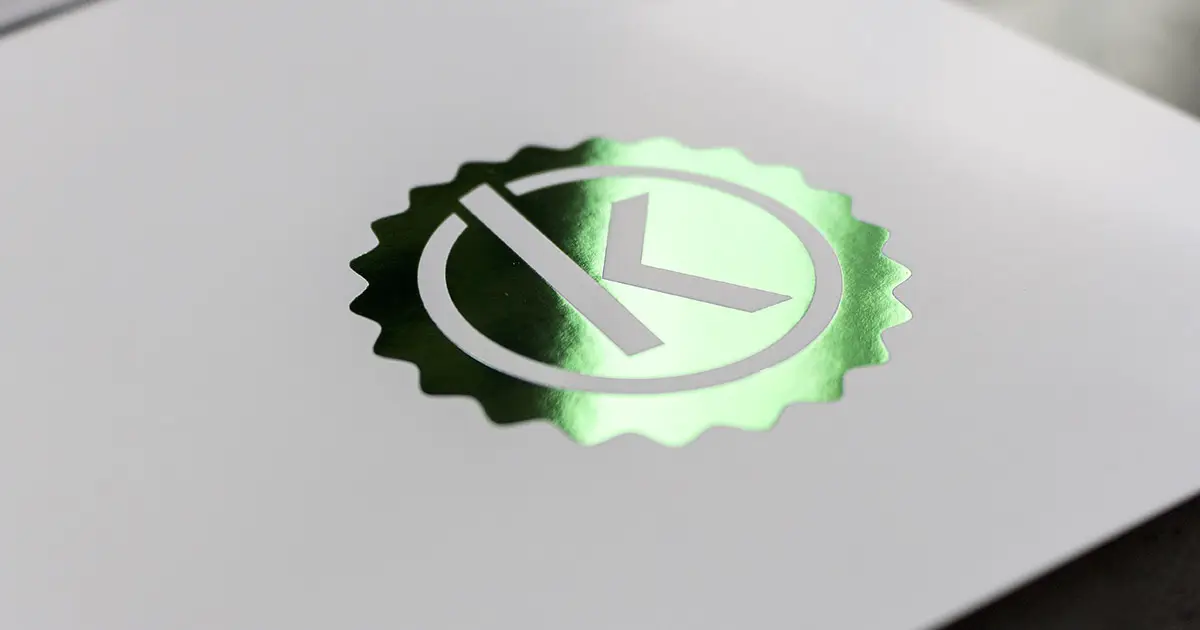
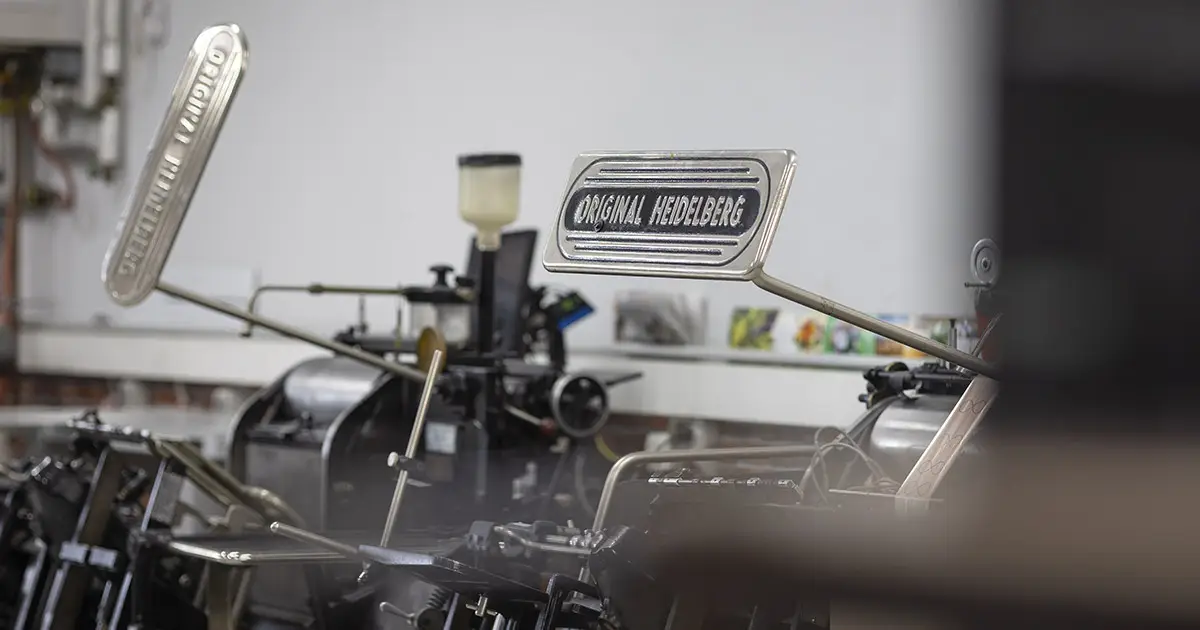
Image: Hot foil stamping produced on an Original Heidelberg Platen Press (Original Heidelberger Tiegel, OHT)
Letterpress
Letterpress printing is done in the traditional manner of Johannes Gutenberg’s era. Instead of individual lead types, today special relief printing plates are used, allowing for playful typography and graphics. In classical letterpress, the printing plate would merely “kiss” the paper, leaving no visible indentations. Today, the embossing effect is intentionally enhanced as a form of print finishing, so that a depression is created simultaneously with the print. This makes the letterpress technique visually and tactilely distinct from offset or digital printing. It is particularly suitable for heavier substrates such as cardboard. The higher the paper bulk (volume), the more pronounced the embossing can be.
Spot colors
In addition to the four process colors—cyan, magenta, yellow, and black, which can be used to reproduce most colors—additional spot colors can be printed in offset printing. Solid colors from the Pantone or HKS systems achieve a level of color stability and vibrancy that cannot always be guaranteed with four-color process printing. Printing with spot colors is particularly recommended for brand manufacturers and companies with precisely defined corporate colors.
Spot colors can also create striking effects. Silver, gold, and copper tones contain reflective metallic pigments. Day-glow colors—so-called neon colors such as yellow, green, or pink—display a special brightness under UV light.
Varnish coating
Varnishes are commonly used in offset printing for protection. Water-based dispersion coatings—matte or glossy—make the paper surface abrasion-resistant. When applied selectively, they create a distinctive contrast between varnished and non-varnished areas.
UV varnish produces an especially glossy and scratch-resistant surface. It can be applied fully or selectively as a spot UV varnish. This effect can be further enhanced with lamination (e.g., matte or soft-touch). Alternatively, a soft-touch UV coating can achieve a similar tactile feel to lamination.
Hybrid coating (Drip-off) is a combination of oil-based primer and UV varnish. First, the primer is applied, leaving out areas that should remain glossy. Then, UV varnish is applied over the entire surface. Where both layers overlap, a reaction occurs—the so-called drip-off or orange peel effect. In these areas, the finish is matte and textured, while the spot-coated areas remain high-gloss.
In relief varnishing, the applied varnish layer is particularly thick. The varnished areas are clearly raised and easy to feel (3D effect).
For scented varnishing, a layer containing microcapsules is applied to the paper. Some of these microcapsules break under mechanical pressure, for example when rubbed with a finger. They contain a fragrance that is then released. This gives the printed product an additional sensory dimension, enhancing its advertising impact. A wide range of scents is available—from Christmas cookies to fruits, plants, and spices, as well as everyday scents such as rubber, tobacco, or asphalt.
Film lamination
Film lamination, also called cellophaning, involves applying a thin plastic film to the paper. Films with different optical effects are used, including matte and high-gloss finishes. So-called soft-touch films provide a special tactile experience due to their rubber-like texture, feeling almost like skin. Textured or relief films can simulate the appearance of various materials, such as linen, leather, or wood.
In addition to the visual effect, film lamination also provides surface protection against abrasion, moisture, dust, and dirt. For example, book covers can be protected from mechanical stress with particularly scratch-resistant films.
Many films can also be combined with a finish using spot UV varnish.