- Brochure production: Saddle stitching, perfect binding, wire-O binding
- Capacity: Over 40 million stitches per year
- Finishing: Cutting, die-cutting, perforating, creasing, embossing
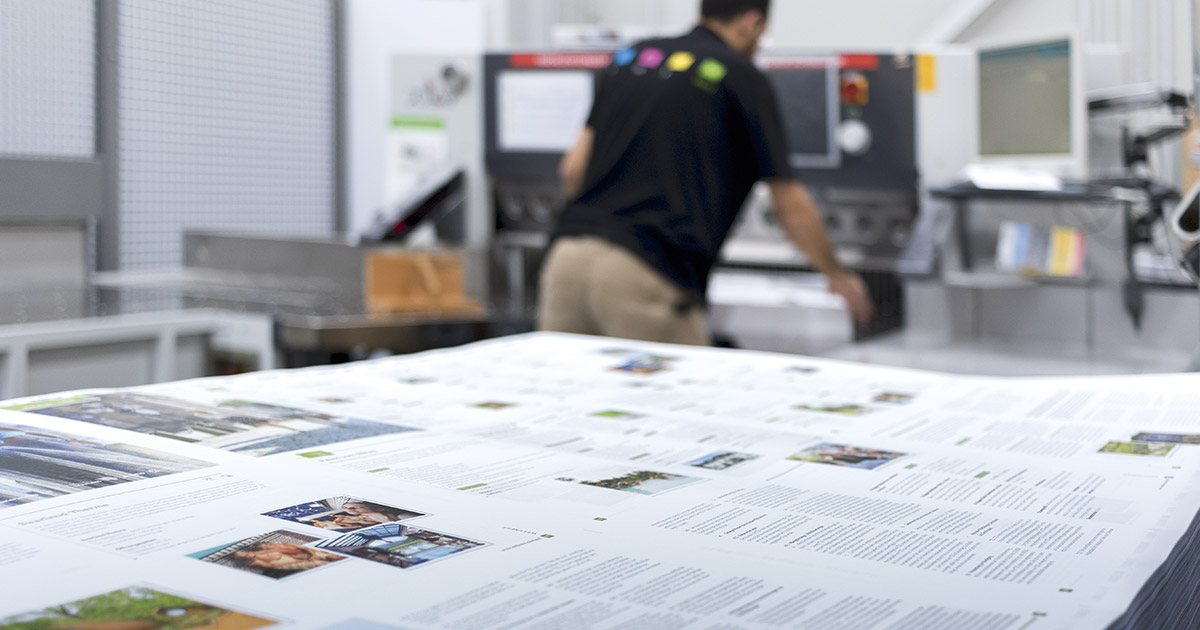
Cutting, shaping, joining, and coating are the basic processes in post-press operations. Complex folding techniques, tipping-on of extras, glue spots, glue lines, die-cutting, scoring, perforating, and embossing—all of these make your product unique and help it stand out. In our workflow, we predominantly rely on Heidelberg’s state-of-the-art technology, even for finishing and further processing.
Cutting and die-cutting
When paper is trimmed, perforated, drilled, or die-cut, it is referred to as "separation" or cutting. Die-cutting options range from rounded corners and index tabs to creative contour and shape cuts—ideal for folders or self-mailers in direct mail production.
Shaping
Folding, scoring, and embossing—including relief and blind embossing—are part of the shaping processes. Various folding techniques are used: simple center folds, zigzag/accordion folds, window/gate folds, roll folds for folders, and cross or parallel folds for posters. In book production, folded signatures serve as intermediate products for final processing on binding and stitching machines.
These are purely mechanical processes, making them fully compatible with Blue Angel (Der Blaue Engel, DE-UZ 195) certified products. Some steps can even be performed in-line on the offset press (One Pass Productivity).
Binding
Binding connects individual parts into a single product—for example, saddle-stitched brochures, glued-top pads, perfect-bound catalogs, or hardcover books with thread sewing. Wire-O or spiral binding is frequently used for manufacturing calendars or notebooks.
Coating
Coating refers to the application of liquid, paste-like, or solid substances to the substrate. Both the printing process itself and varnishing (dispersion or UV) are forms of coating. In print finishing, hot foil stamping is used to create visual and tactile effects that enhance the product's value. Film lamination (cellophaning) provides visual appeal as well as a protective barrier against mechanical stress, dust, and moisture.