- DDE-UZ 195
- Resource-efficient and low in emissions
- Mainly made from recycled paper
- Fully recyclable
- Implemented since: 2020
- Reg. No.: LQ6
Printed products awarded the Blue Angel (Der Blaue Engel) ecolabel are manufactured in a resource-efficient manner, printed with low emissions, and consist primarily of recycled paper. They represent a more sustainable alternative to conventional printed products.
Producing magazines, catalogs, books, and flyers requires energy and resources such as paper and ink. Products made from recycled paper perform significantly better in terms of resource consumption, wastewater impact, and energy use than those made from virgin fibers. They contribute to the conservation of forest ecosystems and waste reduction. The use of compatible inks, varnishes, and adhesives ensures the recyclability of paper fibers. Furthermore, process optimization reduces energy use and emissions of volatile organic compounds (VOCs), which contribute to ozone formation.
Process
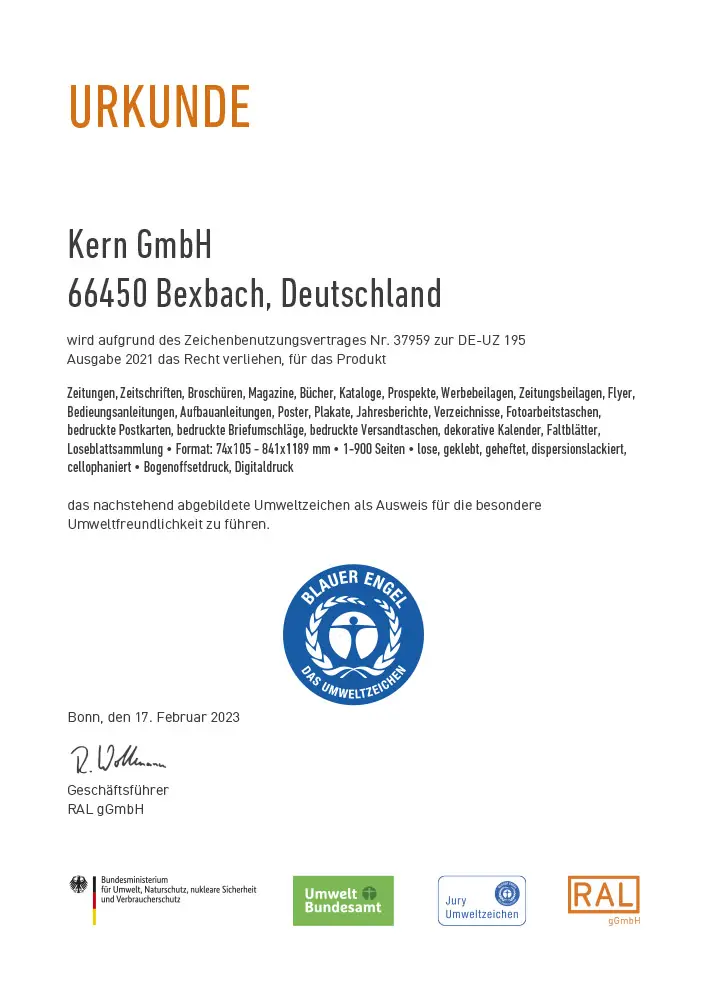
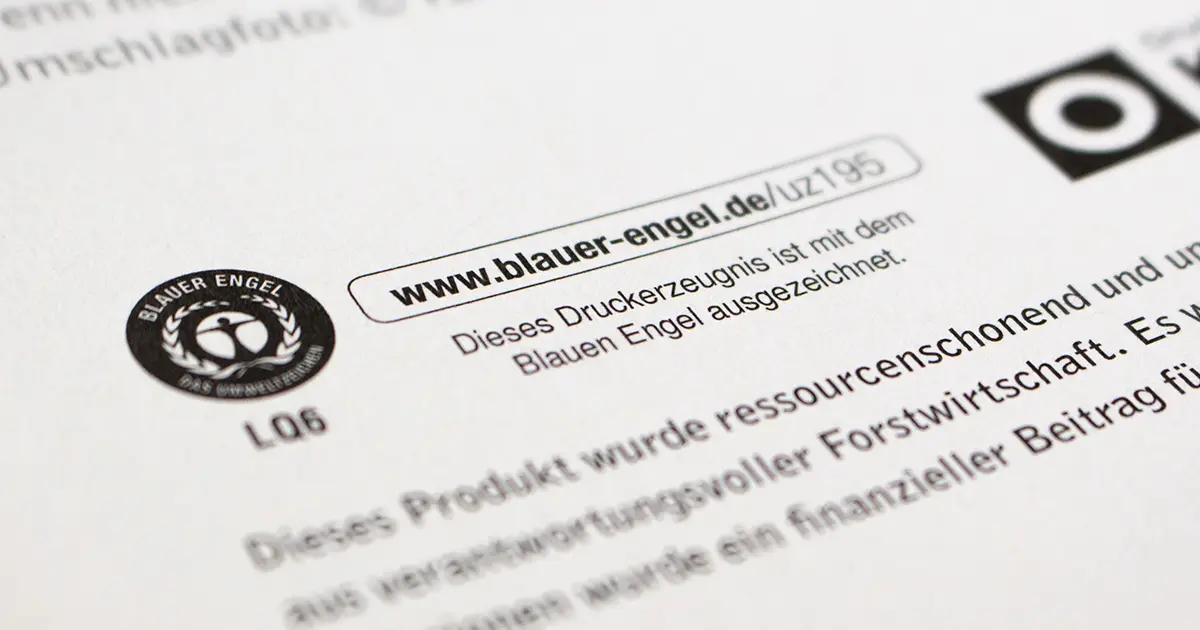
Unlike DE-UZ 14 (recycled paper), the Blue Angel under DE-UZ 195 is not merely a product certification but a certification of the entire printing process. All printed products that meet the defined criteria can be labeled after a simple registration. This significantly reduces administrative effort and lead times: while individual product approvals previously took up to twelve weeks, we can now provide the Blue Angel label much faster, more flexibly, and more cost-effectively.
Only the standard license and processing fees for using the logo apply. These are passed on 1:1 to RAL gGmbH, the official administrative body for the eco-label.
Products
In addition to the offset and digital printing services provided by Kern, the DE-UZ 195 standard covers web offset, rotogravure, and flexographic printing. Please note: Packaging, including printed outer and transport packaging, is excluded from Blue Angel certification under this standard.
The eco-label applies exclusively to printed products consisting predominantly of paper and cardboard, such as books, catalogs, flyers, and posters. The combined proportion of paper, cardboard, ink, and varnish must exceed 90% by mass. Components made of textile, metal, or plastic are not covered by the Blue Angel.
Product specifications
- Application area: Newspapers, magazines, brochures, books, catalogs, booklets, calendars, advertising inserts, user manuals, posters, flyers, placards, loose-leaf collections, personalized self-mailers/mailings
- Format range: 74 × 105 mm to 841 × 1189 mm
- Page count: 1 to 900 pages
- Processing/finishing: loose, glued, stitched
- Coated oapers: Circle Volume Offset Printing (35-250 g/m²), LEIPA ultra MAG (35-70 g/m²), LEIPA ultraMAG PLUS – ULWC/LWC (35-70 g/m²), LEIPA ultraMAG PLUS – MWC/HWC (75-90 g/m²), LEIPA ultraSKY (60-90 g/m²), Steinbeis Charisma Silk/Brilliant (57-90 g/m²), Steinbeis Select (80-130 g/m²)
- Uncoated papers: VIVUS 60/72/80 Print (70-80 g/m²), Vivus 89 (80-300 g/m²), Vivus Color (65-160 g/m²), Circle Offset Premium White (80-350 g/m²), Nautilus Classic (70-300 g/m²), Office/Creative Cardboard (120-350 g/m²), Lettura 72 Office (45-110 g/m²), Lettura 60/72/80 (45-115 g/m²), Envirotop (70-300 g/m²), ENVIRO SMART (60-80 g/m²), Recystar Polar/Nature (70-300 g/m²), Balance Pure (80-350 g/m²)
Requirements for printed products
Components such as inks, coatings, and cleaning agents derived from renewable resources must not originate from deforestation or contain GMOs. PVC plastics and chromium-containing metals are prohibited in the printing process. Adhesives must be DIBP-free, and PUR glues require emission testing and the DGUV seal. For EVA adhesives, specific processing temperatures and machine configurations are mandatory to prevent hazardous emissions.
Print products must not impede fiber recovery. Paper fibers must be deinkable, ensuring ink can be separated from the pulp. Compliance is verified via the “Deinkability Scorecard” using approved testing methods. Similarly, adhesives are evaluated using the European Recovered Paper Council’s (ERPC) “Removability Scorecard”. Non-water-based glues must be fully separable during recycling.
Requirements for printing substrates
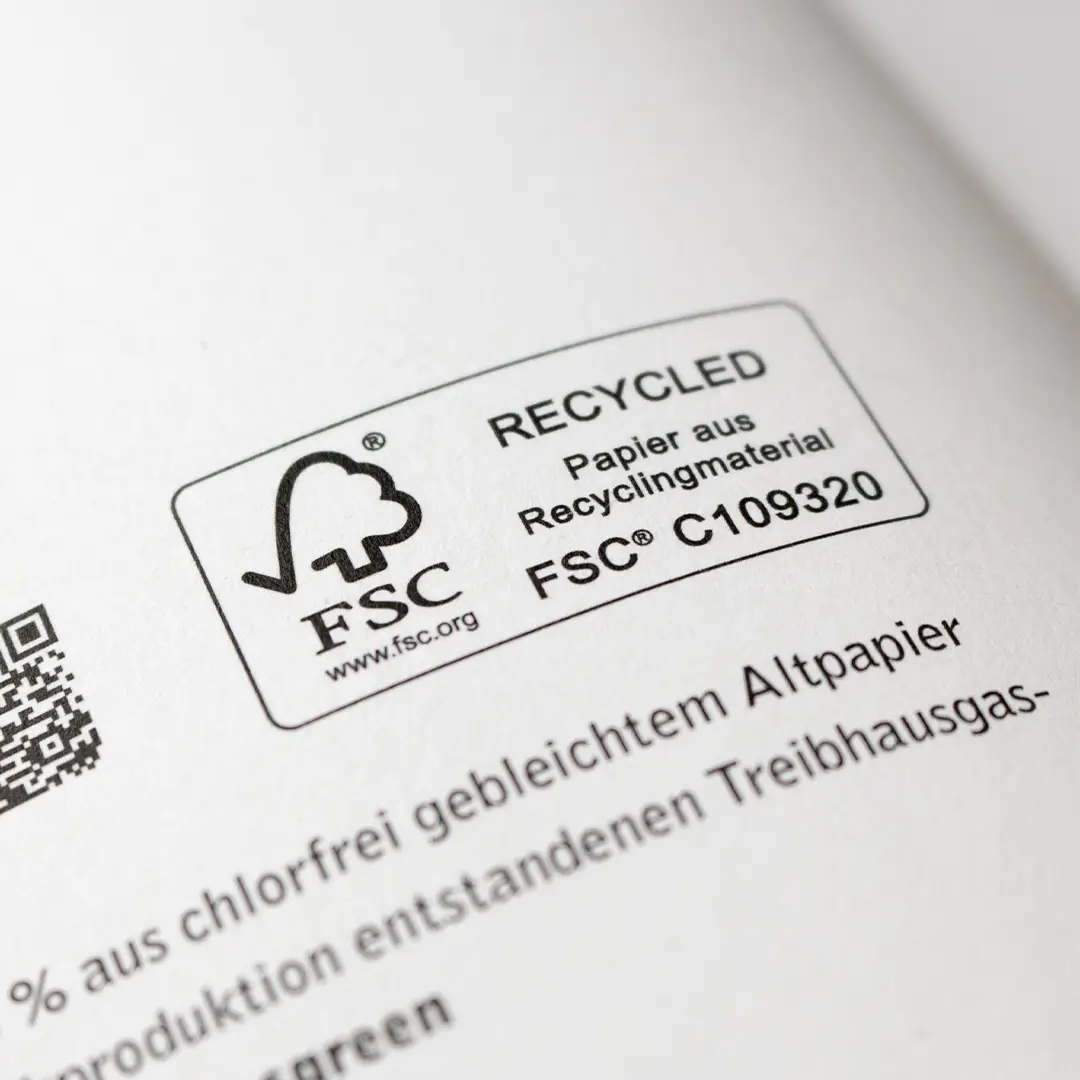
The use of recycled paper is characterized by a more gentle and reduced extraction of wood from forests compared to virgin fiber paper. The production process saves up to 60% energy and 70% water, while significantly reducing climate-damaging CO₂ and other air emissions.
While few print products consist solely of virgin fibers, the market cannot eliminate them entirely. A certain amount of virgin fiber must always be reintroduced into the recycling loop. An eco-friendly print product ideally consists of 100% recycled fibers, or at least a proportion exceeding 50%. Virgin fibers must originate from demonstrably sustainable forestry (FSC or PEFC) and sustainable wood-processing companies. Standards such as DE-UZ 14 and DE-UZ 72 impose the highest process requirements. Products certified with the Blue Angel (DE-UZ 195) must exclusively use such paper. Cardboard products require DE-UZ 56 certification. For digital printing, DE-UZ 14 defines emission limits for the drying process.
Requirements for the printing process
To reduce environmental impact, the production of Blue Angel-certified print products must meet specific criteria compared to conventional media. Besides saving resources—for example, by optimizing paper utilization, reducing spoilage, or minimizing chemical use in plate development—the avoidance of hazardous substances in inks, adhesives, and cleaners is a priority.
Inks, toners, and varnishes must not contain heavy metal compounds like lead, cadmium, chromium VI, cobalt, nickel, or mercury. Copper and manganese compounds are permitted only in strictly limited amounts. Manufacturers also avoid azo dyes and pigments that release carcinogenic amines. Since 2017, inks and varnishes must be free of hazardous hydrocarbons that could contaminate recycled fibers. Optimization of the printing process reduces solvent emissions and ozone formation. Energy efficiency, waste heat recovery, and efficient compressed air systems further support eco-friendly production, backed by ISO 50001, DIN EN 16247, or EMAS. An environmental statement ensures transparent communication of the company's goals and policies.
Requirements at a glance
- Only paper and cardboard print products; no packaging
- Only recycled paper according to DE-UZ 14, 56, and 72
- Minimization of VOC emissions to prevent ozone formation
- Use of low-pollutant, mineral oil-free inks and low-emission adhesives
- High recyclability of the finished product
- Resource efficiency, waste reduction, and minimal chemical use in plate development
- Lower energy consumption through waste heat recovery and efficient compressed air
- Raw and auxiliary materials from non-GMO, sustainable sources (no rainforest deforestation)
- Implementation of ISO 50001 or EMAS environmental management
Related links
- Information about the Blue Angel for print products
https://www.blauer-engel.de/uz195 (German) - Information from the German Environment Agency about the Blue Angel for print products
https://www.umweltbundesamt.de/publikationen/der-blaue-engel-fuer-druckerzeugnisse (German) - Info portal "Sustainable publishing"
http://greenpublishing.de (German) - Myths and facts about paper
https://twosides.info